Do you often find yourself avoiding situations or tasks that trigger your anxiety? Do you feel a temporary sense of relief when you do this, only to experience increased anxiety in the long run?
If so, you’re not alone. Avoidance is often mistaken as an easy coping mechanism, and it can quickly turn into a relentless cycle that leaves you feeling more anxious that you were at first. The good news is that there are practical steps you can take to break free from the cycle of avoidance, especially with clinical support.
In this guide, we’ll break down exactly how the cycle works, walk through a real-world example of it in action, cover strategies to interrupt it, and explain when avoidance has crossed from “a bad habit” into a sign of a treatable anxiety condition.
What Is the Cycle of Avoidance?
The cycle of avoidance, or the anxiety avoidance cycle, refers to the pattern of avoiding a situation or task after feeling anxious about it, then experiencing reinforced anxiety in the long run as a result. It typically moves through four stages:
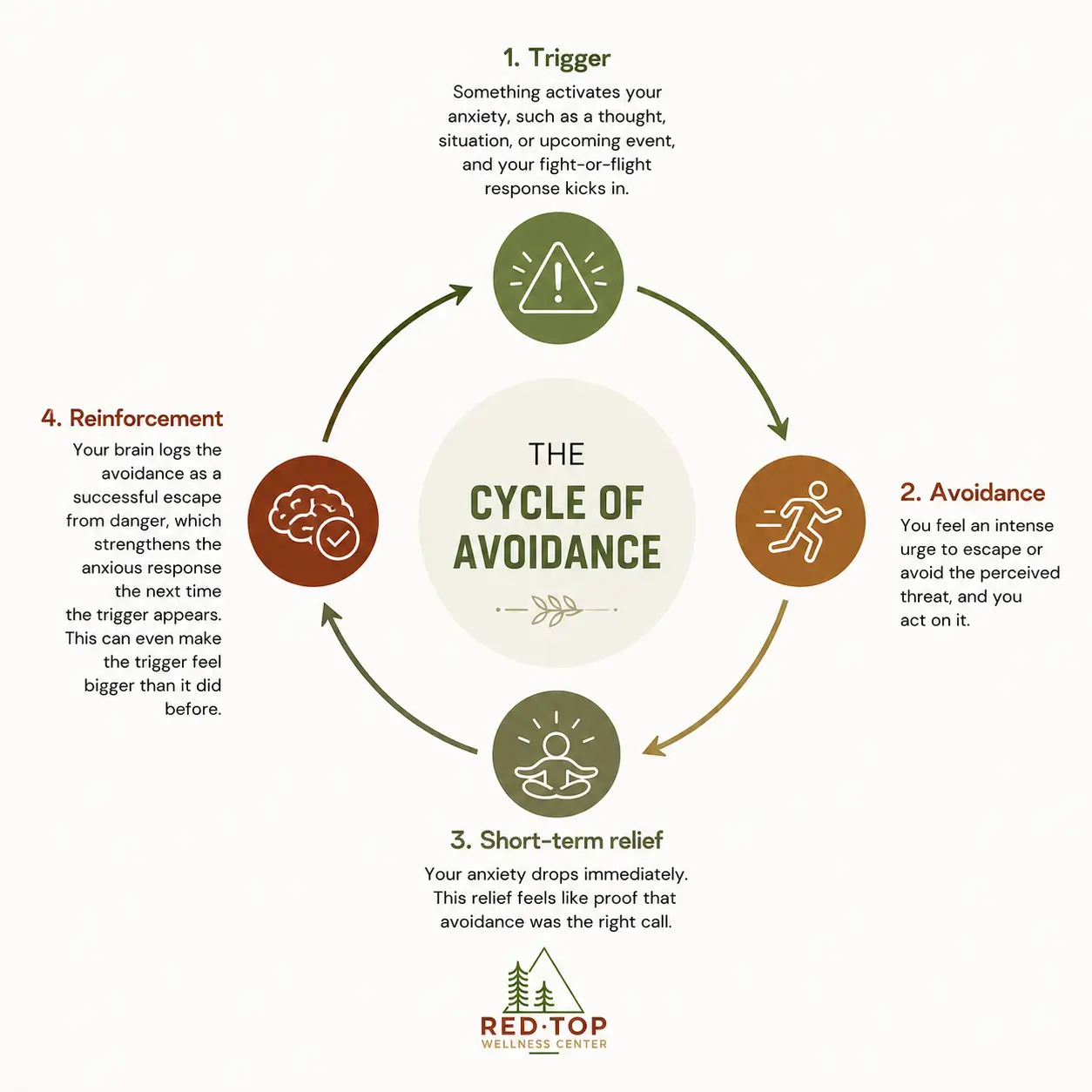
- Trigger: Something activates your anxiety, such as a thought, situation, or upcoming event, and your fight-or-flight response kicks in.
- Avoidance: You feel an intense urge to escape or avoid the perceived threat, and you act on it.
- Short-term relief: Your anxiety drops immediately. This relief feels like proof that avoidance was the right call.
- Reinforcement: Your brain logs the avoidance as a successful escape from danger, which strengthens the anxious response the next time the trigger appears. This can even make the trigger feel bigger than it did before.
Instead of finding ways to combat anxiety, avoiding the situation altogether actually launches a cycle in which anxiety worsens over time. Think of it like breaking a bone and taking medicine to mask the pain. You’ve avoided dealing with the injury temporarily, but putting off real treatment will only make the situation worse as time goes on.
This is what makes the cycle so deceptive: avoidance works in the moment. It’s the long-term reinforcement that narrows your life.
What The Cycle of Avoidance Looks Like
Avoidance is a natural human response to anxiety, but it may also be a symptom of an anxiety disorder, such as social anxiety disorder or certain phobias. To get to the root of your avoidance behaviors, consider how you fall into the cycle in your day-to-day life. It could look like:
- Not answering the phone when it rings
- Avoiding social gatherings or turning down invitations at the last minute
- Procrastinating task completion until the deadline forces your hand
- Putting off decision-making because of anxiety
- Rehearsing excuses in advance so you have an “out” ready
- Choosing routes, seats, or schedules specifically to reduce contact with a feared situation
An Example of The Anxiety Avoidance Cycle in Real Life
Anxiety can manifest in various situations, and the trigger that sends someone into the cycle of avoidance can look different for everyone. Maybe it’s an awkward social situation or a challenging task at work. For example, let’s say you’re asked to give a short update at a team meeting:
- Trigger: You get the calendar invite. Your stomach drops, and you immediately worry about freezing up in front of your colleagues.
- Avoidance: You email your manager and ask to skip your turn, citing a scheduling conflict that isn’t entirely true.
- Short-term relief: Your manager lets you skip the meeting, and you feel a wave of relief. The meeting comes and goes without requiring you to attend at all.
- Reinforcement: The next time a presentation comes up, your anxiety is even worse. Your brain has learned avoidance keeps you safe from the trigger that makes you anxious, so it pushes harder for avoidance the next time. Meanwhile, you’ve missed a chance to build the evidence that you can handle it.
The above example is just one way the cycle of avoidance may spiral out of control, but it can take control even in emails you don’t answer, calls you let go to voicemail, and plans you cancel. Although these individual decisions may feel small and reasonable at the time, it’s easy to see how avoidance can quietly shrink someone’s world over months or years.
Is the Anxiety Avoidance Cycle a Clinical Concern?
Everyone avoids things sometimes. It’s completely normal. But avoidance may point to a diagnosable, treatable condition when it starts to meaningfully limit daily life.
Signs your experience with the cycle of avoidance may be more than an occasional habit include:
- The avoidance has narrowed your routine. For example, certain roads, buildings, foods, or types of interactions are now permanently off-limits.
- You’re organizing significant parts of your schedule, career, or relationships around what you can avoid.
- Physical symptoms (racing heart, shortness of breath, sweating, nausea) accompany the anxious trigger.
- The pattern has persisted for six months or more, or is getting worse rather than better.
- Self-directed strategies like grounding and reframing haven’t been enough to change the pattern.
When avoidance is a core symptom the brain has built around a persistent threat response, it turns into a real mental health condition. If this sounds familiar, it’s worth talking to a mental health professional. For people whose avoidance has become severe enough to disrupt work, relationships, or daily functioning, inpatient anxiety treatment can provide the intensive support and distance from daily triggers needed to make lasting progress.
How to Break the Cycle of Avoidance
Avoidance can become a habit that prevents us from fully experiencing life, leading to missed opportunities and stalled personal growth. Breaking the pattern means getting to the root of the problem by identifying the avoidant behavior and treating the underlying anxiety rather than only managing the moment.
Here are some practical strategies:
1. Seek Residential Anxiety Treatment
While there are some steps you can take in your personal life to manage day-to-day moments of anxiety, it often takes a structured, multi-pronged treatment approach to break the anxiety avoidance cycle that’s deeply established. At Red Top Wellness Center, our approach to inpatient anxiety treatment draws on multiple therapeutic modalities, since no single technique works the same way for every person or every type of avoidance.
Our program typically combines:
- Cognitive-behavioral therapy (CBT), which helps you identify and challenge the negative thought patterns that fuel avoidance. For example, you might reframe thoughts like, “I’m going to embarrass myself” into “I feel nervous, but I’ve handled hard conversations before.”
- Exposure-based therapies, which help you practice approaching feared situations with structured guidance from your primary therapist.
- Group therapy, which offers a low-stakes environment to practice engaging in social situations alongside peers who are working through similar challenges.
- Medication management, when appropriate, to help reduce the intensity of the physical anxiety response so that behavioral strategies have room to work.
- Holistic and recreational therapies, such as mindfulness-based practices or red light therapy, which reinforce grounding skills and support emotional regulation.
Residential anxiety treatment offers a level of deeper level of support than outpatient therapy, which is especially important for people who feel stuck in the cycle of avoidance. Staying in a residential facility offers you a peaceful space to work through your anxiety symptoms, without becoming re-triggered by something in your everyday environment.
2. Use Grounding Techniques
Grounding techniques encourage you to focus on the present moment and become more aware of your surroundings rather than getting lost in anxious thoughts. Examples include:
- Deep breathing exercises
- Mindfulness meditation
- Sensory activities like taking a warm bath or listening to calming music
By bringing attention to the present moment, you can observe thoughts and feelings without judgment or reaction. This helps you respond to situations constructively rather than react out of fear.
3. Practice Gradual Exposure
One of the most well-supported ways to break the cycle is to approach the trigger in small, manageable steps. This technique is often called graded exposure. Rather than jumping straight into the most anxiety-provoking version of a situation, you build tolerance gradually.
Here’s what gradual exposure might look like:
- Start with a lower-stakes version of the trigger (e.g., speaking up in a small team huddle before a full department meeting).
- Stay in the situation long enough for the anxiety to naturally rise and then fall on its own.
- Repeat, gradually increasing the difficulty as confidence builds.
This works because it gives your brain new evidence that directly counters the reinforcement stage of the anxiety avoidance cycle. You’ll realize that the feared outcome didn’t happen, or that you could tolerate it if it did, and you’ll feel better prepared to approach the situation the next time it arises.
Visit Red Top Wellness Center for Residential Anxiety Treatment
Taking proactive steps to confront your anxiety is the best way to stop the cycle of avoidance before it even begins. But if you’re already somewhere within that cycle, or if the cycle is exacerbating symptoms of another mental health struggle, it may be time to seek professional help.
At Red Top Wellness Center, we prioritize the mental wellbeing of all our patients with utmost dedication. Our facility provides evidence-based treatment of mental health disorders backed by scientific research. We offer personalized care in a nurturing environment that promotes healing and recovery for everyone who walks through our doors.
To learn more about our specialized programs and therapies, reach out to our team today by calling us at (470) 684-3324 or filling out our online contact form.